What Is CT3309361 and Why It Exists
CT3309361 is a standardized identifier used to uniquely define and track specific elements within modern technical and operational systems. It exists to remove ambiguity and ensure that data, processes, or components can be identified with complete accuracy. As systems grow more complex, such identifiers help maintain consistency across platforms and departments. They support better organization by replacing unclear naming methods with a reliable reference structure. The idea was born out of increasing need for efficiency, traceability and error minimization.
This allows for easier integration with systems and quicker access to data. This approach also plays a key role in automation and digital record management. In regulated environments, it supports compliance and audit readiness. By improving data integrity, overall system reliability increases. This makes such identifiers essential for modern industries operating at scale. They also support long-term scalability and easier future upgrades. CT3309361 helps teams collaborate more effectively by using a shared and trusted reference point.
Where CT3309361 Is Commonly Used
CT3309361 is commonly used in environments where accuracy, tracking, and system coordination are critical. It is found in technology-driven systems such as software platforms, data management tools, and automated workflows. Many industrial setups use this type of identifier in manufacturing control, equipment tracking, and process monitoring. In commercial operations, it supports transaction handling, inventory management, and internal record systems.
It is widely adopted because it simplifies complex structures and reduces operational errors. Usage may differ across digital platforms, hardware management systems, and documentation processes. Some organizations apply it for internal tracking, while others use it to connect multiple systems together. Its flexible nature allows it to function across different sectors. It adapts easily to varying operational requirements. This wide usage makes it a dependable reference in diverse working environments.
Technical Characteristics of CT3309361
This section explains the technical nature of CT3309361 by focusing on how it operates within a structured system and what makes it technically reliable. It acts as a knowable point of reference to which systems can attach, process, and manage unique things without conflict. Its internal structure is organized so that a uniform schema is used, allowing for multi-platform/environment compatibility. From stovepipe to system operation, it promotes good system flow through precise references of related components.
Characteristics such as stability, predictability, and very low tolerance to errors are required in the properties of performance for such automated or data driven application. It also operates well with databases, logic software, and control. These attributes contribute to minimize the system crashes and processing waits. The technical design also supports scalability, allowing systems to expand without losing accuracy. For this reason, the technical features of the system have a significant impact on its long-term reliability.
Specifications and Key Features of CT3309361
Core Technical Specifications
This subsection explains the core specifications that define CT3309361, including its configuration structure, operational scope, and baseline technical standards. These characteristics define how it is classified in a system and what kind of tasks it can handle efficiently. Awareness of these quantifiable properties enables the reader to assess the size, range, and applicability to various technological or business areas of use. Clear specifications also make comparison and implementation easier across varied system environments. These details provide a solid foundation for informed technical decision-making.
Performance and Efficiency Characteristics
CT3309361 performs during both routine operations and high-demand conditions. Among other things, it emphasized efficiency, stability and consistency of these properties over time as factors enabling reproducible results. The discussion describes the reduction of processing faults, system drags and unexpected terminations through performance tuning. Such characteristics are especially valuable in large-scale or continuous-use systems where uptime and accuracy are critical. Consistent performance also supports predictable system behavior.
Compatibility With Systems and Devices
This subsection describes how it integrates with existing systems, platforms, and devices. It explains how it works alongside different technologies without disrupting existing workflows. It covers supported environments, interoperability factors, and flexibility during integration. The focus is on helping users understand whether it can be implemented within their current setup without requiring extensive redesigns or costly adjustments. Good compatibility also contributes to the upgrade and the system expansion in a long term. This flexibility reduces integration risks and supports stable system growth over time.
Design, Build Quality, and Durability
Reliable performance starts with smart design and careful construction. Design principles and good construction practice that enable systems to perform reliably in challenging environments. Durable build standards help ensure stable operation over extended periods, making them suitable for environments where reliability and continuous performance are essential. A robust design also minimizes maintenance needs over time, supporting smooth and uninterrupted operations.
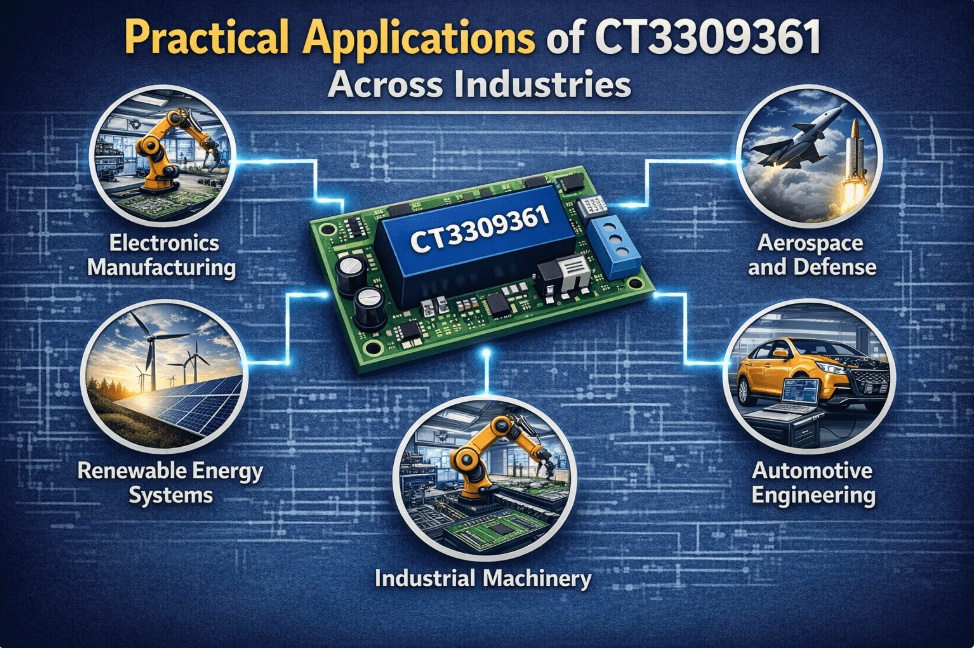
Practical Applications of CT3309361 Across Industries
Electronics Manufacturing
In the production of electronics, CT3309361 is employed to enable high precision, uniformity and quality assurance during production processes. It helps manufacturers track components, manage assembly stages, and maintain uniform performance standards. By reducing variation and identification errors, it contributes to smoother workflows and higher reliability in finished electronic products. This also supports faster inspections and easier troubleshooting during production. As production volumes increase, it helps maintain accuracy without slowing operations.
Automotive Engineering
Within automotive engineering, CT3309361 plays an important role where accuracy and reliability directly affect safety and performance. It is commonly applied in system integration, component validation, and testing processes. Its structured use helps ensure that parts and subsystems align correctly within complex vehicle architectures. This improves consistency in manufacturing and supports long-term vehicle durability. It also assists in quality audits and performance evaluations.
Industrial Machinery
Among industrial machinery equipments, it is also used in heavy machinery, manufacturing lines and control systems. The machinery part provides the management of components of machines, operational sequences, and monitoring of performance. Accurate identification is of the essence in these environments, where even small deviations from the norm will have an effect on productivity. Its application contributes to the continuity of operation, to the reduction of downtime and to the improvement of maintenance scheduling. This results in better utilization of the resources.
Aerospace and Defense
Aerospace and defense sectors rely on it in environments that demand strict compliance, precision, and system dependability. It’s designed for mission-critical applications where you can’t afford to fail. Its systematic approach enables traceability, documentability and compliance with strict technical requirements. This makes it valuable for both operational reliability and regulatory alignment. It also enables long-term system verification and management of its lifecycle.
Renewable Energy Systems
It enables easy system monitoring and performance management in renewable energy systems (solar, wind, energy storage, etc.). It helps manage components and operational data across distributed systems. This improves system visibility and long-term reliability while supporting sustainability goals. Its role becomes increasingly important as clean energy infrastructure continues to expand and scale. It also aids in predictive maintenance and performance optimization.
Benefits of Using CT3309361 in Modern Systems
Modern systems benefit greatly from structured identifiers that improve clarity and control. Improved reliability is one of the strongest advantages, as fewer identification errors lead to smoother operations. Better organization allows teams to manage complex systems more efficiently. This ultimately reduces maintenance and unexpected downtime over time. Cost efficiency increases as processes are more predictable and can be optimized more efficiently. Scalability is also a key strength, as systems can be scaled without redesign.
Many engineers rely on CT3309361 because it supports future-ready architectures. Clear references improve coordination between system layers. Data handling becomes faster and more accurate. Overall system transparency increases, making performance analysis easier. Workflow visibility improves across departments. Training new team members becomes simpler. System documentation stays more consistent. Decision-making is supported by cleaner data. Long-term planning becomes more reliable.
How to Identify Genuine or Compatible CT3309361
Correct identification is essential before integrating any structured reference into a system. Reviewing technical documentation and official specifications is the first step. Compatibility checks ensure alignment with existing platforms and supported standards. Supplier verification helps avoid low-quality or mismatched components. Proper validation reduces the risk of failures during operation. Long-term system stability depends on correct selection. When CT3309361 is verified correctly, performance consistency improves.
Documentation also helps during audits and troubleshooting. Compatibility testing minimizes integration delays. Overall trust in system components increases. Quality assurance processes become stronger. Procurement risks are reduced significantly. System lifespan is extended. Unexpected failures are minimized. Integration confidence improves. Clear identification also supports smoother upgrades in the future. Standardized verification reduces confusion across teams.
How Users Should Approach CT3309361 Before Use
A careful approach before implementation helps avoid costly issues later. Users should analyze system requirements and operating conditions in advance. Understanding limitations prevents performance mismatches. Planning integration steps ensures smoother deployment. Future expansion should be considered during evaluation. Testing in controlled environments is highly recommended. When planning involves CT3309361, alignment with system goals becomes clearer. Risk analysis enables better decisions.
Teams coordinate better with defined implementation steps. Maintenance planning becomes simpler and more predictable. Documentation should be prepared in advance. Backup strategies should be considered. Monitoring plans improve post-deployment performance. Clear ownership reduces operational confusion. Long-term support becomes easier to manage. Early preparation improves system confidence. Implementation timelines become more realistic and controlled.
Conclusion
Structured identifiers continue to play an important role in modern technical environments. They support accuracy, efficiency, and stable system behavior. Across industries, such solutions simplify complex operations. Informed usage leads to better long-term outcomes. Reliability and scalability remain key reasons for adoption. As systems evolve, CT3309361 remains a dependable reference. It supports adaptation to new technical demands. Performance consistency improves over time.
Operational uncertainty is reduced. Overall, it contributes to building future-ready systems. Clear understanding leads to smarter implementation. Long-term value outweighs initial effort. System confidence increases across teams. Technical alignment improves steadily. Sustainable growth becomes achievable. Consistent standards support long-term success. Well-planned usage strengthens overall system resilience.
FAQs
Q1: Is CT3309361 a product or a reference code?
A: In most cases it is a reference or an identification number, and not a product for consumer. It shows up in documentation, system logs, and internal processes.
Q2: For which industries is it most useful?
A: Industries like electronics production, automotive engineering, industrial machinery, aerospace, defense, and renewable energy depend on structured identifiers like this one.
Q3: Does it help improve efficiency?
A: Although it does not affect performance directly, proper identification ensures that the workflows are not disrupted, enabling a more efficient processing with less operational problems.
Q4: Will it remain relevant in the future?
A: Yes, With the increasing complexity of systems, hierarchical identifiers maintain their importance in system scalability, maintenance, and management for the long term.